
How a Consolidated Service Center Transforms Health System Performance
Health systems today are under pressure to do more with less. They need to expand access, improve patient care, and manage increasingly complex medication supply chains with fewer staff, tighter operating margins, limited physical space, and increasing regulatory and reimbursement pressures. Amidst all of this, pharmacy services are expanding beyond the hospital walls into ambulatory, retail, and specialty settings.
Because of the increased pressures with decreased resources, many organizations are operating across disconnected sites, workflows, and systems. This limits their ability to scale efficiently or fully capture financial value. The solution: a consolidated service center spanning the full pharmacy footprint.
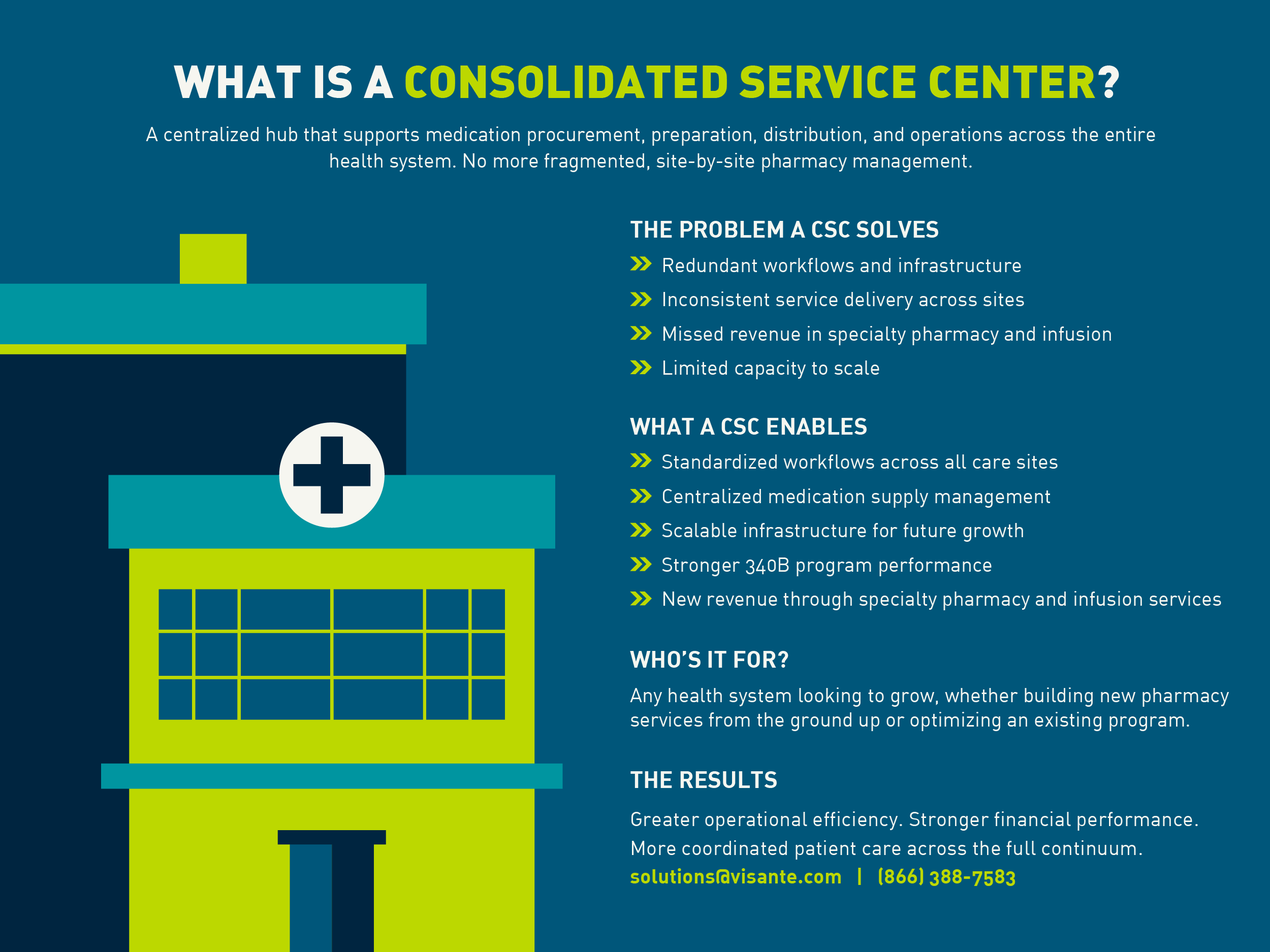
What Is a Consolidated Service Center?
A pharmacy consolidated service center (CSC) is a centralized support hub and integrated operating model designed to support a range of strategic functions across the health system, including medication procurement, preparation, distribution, and other operational initiatives.
Rather than duplicating services across multiple locations, a CSC enables standardized workflows that reinforce a system-first approach, centralized medication supply management, and scalable support for multiple care sites—all of which improve operational efficiency and create capacity for future growth.
What Type of Health System Benefits From a CSC?
A CSC is not a one-size-fits-all solution. However, it is a solution for a wide range of health systems. Hospitals can use a CSC as a foundation to build new services, like specialty pharmacy or infusion solutions. Health systems with existing pharmacy programs can leverage a CSC to optimize operations, standardize across sites, and support continued growth. In both cases, the goal is the same: a more connected, efficient, and scalable pharmacy model.
Fragmented Pharmacy Services in a Growing Health System
As health systems grow, pharmacy operations often evolve in silos. Decisions about staffing, distribution, and facility design are made at the site level rather than across the enterprise. Over time, this leads to:
- Inefficient medication supply distribution
- Redundant workflows and infrastructure
- Inconsistent service delivery across the system
- Missed opportunities in high-growth areas like specialty pharmacy and infusion
Without a CSC, pharmacy services compete for scarce space inside aging hospital facilities, where renovations are costly and any square footage dedicated to non-revenue-generating or non-clinical functions is a missed opportunity. These challenges are operational, and they directly impact financial performance and patient care.
Connecting Pharmacy Services Through a CSC
Decentralized models are difficult to sustain, especially as demand grows for specialty medications, ambulatory services, and integrated care delivery. A centralized pharmacy approach helps organizations:
- Improve efficiency and reduce operational costs
- Strengthen control over medication supply
- Support system-wide growth without duplicating resources
- Enhance consistency in pharmacy services delivery
Most importantly, it creates the infrastructure needed to deliver more coordinated patient care across the continuum. Most health systems are already pursuing this strategy of connecting all sites of care so patients can flow seamlessly. Operations have to match that strategy, supported by systemness and a facility designed to enable it. That alignment is what ultimately drives financial gains.
But infrastructure alone doesn’t drive performance—the physical environment plays a critical supporting role. Too often, organizations approach facility design as a standalone initiative when, in reality, the physical space should be shaped by the operations that execute the strategy, not the other way around. Realizing the full potential of a CSC requires intentional facility design that supports the operational model from the ground up by enabling:
- Optimized workflow and throughput
- Efficient medication preparation and distribution
- Scalable infrastructure for future growth
- Environments that support regulatory compliance and quality
- Flexible space to adapt to evolving services and technologies
When aligned with an enterprise pharmacy strategy, facility design becomes an enabler of performance and not just a capital project. The next step is making sure that foundation connects every point of care across the system.
The Integrated Pharmacy Enterprise
A connected pharmacy enterprise spans the full care continuum, from high-convenience, lower-complexity settings to highly specialized clinical environments:
- Home, mail services, and virtual care
- Retail and ambulatory pharmacy
- Clinics and physician offices
- Ambulatory infusion suites and infusion centers
- Specialty pharmacy
- Hospitals and cancer centers
Four operational pillars hold it together: medication access, revenue cycle management, supply chain optimization, and 340B program integrity. Together, they drive performance across the entire system.
The payoff is tangible. Patients get consistent, coordinated pharmacy services as they move between settings, from a physician office to an infusion center to home infusion. Health systems unlock system-wide value: greater operational efficiency, more coordinated clinical care, and stronger financial performance through reduced operational costs, optimized 340B performance, and new revenue opportunities in specialty pharmacy and infusion services.
Taking the First Step Toward a CSC
Transformation starts with an honest assessment of where your health system is today. Before investing in new infrastructure or expanding services, leaders should be able to answer a few foundational questions:
- Does your current pharmacy infrastructure have the capacity to support system-wide growth?
- Where are services fragmented, duplicated, or falling short of their potential?
- Are your pharmacy operations aligned across sites, or are decisions still being made in silos?
In many cases, this assessment surfaces opportunities that have been obscured by years of reactive, site-level decision-making. Inefficiencies become visible, revenue gaps emerge, and the case for centralization becomes clear.
From there, the path forward typically begins with establishing a CSC as the operational foundation.
Finding the right partner to guide that process, from strategy through facility design and implementation, is one of the most important decisions a health system can make.
That’s where Visante comes in. We partner with health systems from initial assessment and strategic planning to CSC design, implementation, and beyond.
A Consolidated Service Center: The Foundation for Long-Term Pharmacy Performance
A consolidated service center is a strategic foundation for how health systems grow, compete, and deliver care. When pharmacy services, facility design, and system-wide strategy are aligned, it results in greater efficiency, stronger financial performance, expanded medication access, and better patient outcomes.
If your organization is ready to move from fragmented operations to a high-performing pharmacy model, we’re ready to help. Get in touch with Visante today!